OWI Meaning in Law: OWI vs DUI, Charges & State Rules
OWI most commonly means Operating While Intoxicated. It refers to an impaired-driving offense used in several U.S. jurisdictions and may involve alcohol, drugs, or both. OWI is related to DUI and DWI, but the official name, legal elements, and possible penalties depend on state law. Being charged with OWI means the government has made an allegation; it does not mean the person has been convicted.

What Does OWI Mean in Law and Police Records?
In legal and police records, OWI usually refers to an impaired-driving allegation involving the operation of a motor vehicle while affected by alcohol, drugs, or another prohibited substance. The exact statutory wording varies by state.
OWI is an acronym, not one nationwide federal offense. Each jurisdiction defines the conduct through its own state statute. Depending on that law, a case may involve alcohol concentration, a controlled substance, prescription medication, or other evidence that the person’s ability to operate safely was impaired.
“Intoxicated” does not always mean visibly drunk. Some statutes address measurable alcohol or drug conditions as well as observed impairment, and the required proof differs by jurisdiction.
A police report, citation, or court record may use OWI as an offense label, an arrest category, or shorthand for the suspected violation. Readers should check the state, statute number, and case status shown on the document before deciding what the entry means.
Arrested or Charged With OWI—What Does Each Stage Mean?
- Investigation: Police collect observations, statements, records, and test evidence.
- Arrest or citation: The person is taken into custody or ordered to answer an alleged offense.
- Formal charge: The government files or pursues a criminal allegation.
- Plea or trial: The accused enters a plea, or the case is decided in court.
- Conviction and sentence: A sentence follows only if guilt is established by a plea or court finding.
An arrest does not establish guilt, and a charge remains an allegation. A conviction follows a guilty plea or a finding of guilt; sentencing is the later stage when the court imposes consequences.
An “OWI charge sentence” is not imposed merely because someone was arrested, cited, or charged. Administrative action affecting a driver’s license may begin on a different timetable from the criminal case, depending on the jurisdiction.
OWI vs DUI vs DWI—What Is the Difference?
OWI, DUI and DWI all relate to impaired driving, but they are not universal or automatically interchangeable legal labels. The governing statute—not the acronym alone—determines the elements, classification and penalties.
| Term | Common expansion | Main wording | Example use | Reader warning |
|---|---|---|---|---|
| OWI | Operating While Intoxicated | Operating | Several Midwestern states | Exact definition varies |
| DUI | Driving Under the Influence | Driving | Common public and statutory term | May cover alcohol and drugs |
| DWI | Driving While Intoxicated or Impaired | Driving | Expansion differs by state | Do not assume one definition |
| OVI | Operating a Vehicle Impaired | Operating a vehicle | Commonly associated with Ohio | State-specific term |
| OUI | Operating Under the Influence | Operating | Used in certain states | Not the French word “oui” |
Is OWI Worse Than DUI?
OWI is not automatically worse than DUI. The label used on a citation does not, by itself, show whether the alleged offense is a misdemeanor or felony, what must be proved, or what sentence may follow.
Seriousness may depend on prior impaired-driving offenses, blood alcohol concentration (BAC) or another prohibited concentration, drug involvement, injury or death, a child passenger, chemical-test refusal, and the person’s license status. State law may also create different offense levels for particular facts. Compare the cited statute and charge level rather than placing OWI, DUI and DWI in one national severity ranking.
Driving vs Operating—Why the Wording Matters
“Driving” usually describes movement of a vehicle. “Operating” may be interpreted more broadly in some jurisdictions, but the meaning comes from the controlling statute and court decisions.
Courts may examine vehicle movement, engine status, where the person was seated, possession of keys, the vehicle’s location and whether the person could put it in motion. The related phrase actual physical control means having present control over a vehicle even when it is not moving, where the jurisdiction recognizes that test.
| Situation | Correct treatment |
|---|---|
| Vehicle moving | Usually fits driving or operating |
| Engine running while parked | May satisfy operation in some jurisdictions |
| Person sleeping in the vehicle | Depends on the facts and state law |
| Keys nearby but engine off | Do not state a universal result |
No single parked-car rule applies nationwide. Sitting in a parked vehicle—or having keys available—does not automatically produce the same legal result in every state.
Which States Use OWI?
OWI terminology is strongly associated with Wisconsin, Iowa, Michigan and Indiana, but each state defines its own offense. The short descriptions below were checked on June 16, 2026.
| State | Current terminology | Primary source checked |
|---|---|---|
| Wisconsin | Operating While Intoxicated; PAC is a separate prohibited-concentration theory | Wisconsin DOT and Wis. Stat. § 346.63 |
| Iowa | Chapter 321J is titled Operating While Intoxicated; § 321J.2 covers operation under the influence or with a prohibited concentration | 2026 Iowa Code |
| Michigan | Operating While Intoxicated; related provisions address Operating While Visibly Impaired and high bodily alcohol content | Michigan Judicial Institute and Michigan State Police |
| Indiana | Operating a Vehicle While Intoxicated, with offenses defined under Indiana law | Indiana BMV and Criminal Justice Institute |
This table identifies current terminology; it does not replace the statute, court decisions or advice based on a person’s facts. Readers should distinguish the formal offense title from shorthand used by police, news reports, lawyers or the public. An agency page may summarize the rule, while the current code supplies the controlling text.
Why Do States Use Different Impaired-Driving Terms?
States enact and amend their own criminal and traffic laws, so the formal charge name depends on the jurisdiction. The public may say “DUI” even where a citation or court record uses OWI.
Different acronyms do not necessarily mark different levels of seriousness. Nor do all OWI states apply the same definition of “operating.” The statute number on the document is more reliable than the conversational label.
What Can Support an OWI Charge?
An OWI allegation may be based on impairment evidence, a prohibited alcohol concentration, a drug-related provision, or more than one theory.
Evidence of impairment: Police and prosecutors may rely on driving behavior, physical observations, statements, field testing and other admissible evidence. No single observation proves guilt on its own; the required proof and permitted evidence depend on the jurisdiction.
Prohibited alcohol concentration: BAC means blood alcohol concentration. State law may create an offense based on a measured concentration, with different rules for driver category, age, prior history or vehicle type. A result below one stated threshold does not automatically prevent an impairment allegation.
Drug-related operation: A case may involve illegal drugs, controlled substances, prescription medicine, over-the-counter medicine, or alcohol combined with another substance. Breath, blood or urine testing may provide evidence, but the legal effect of a result—or a refusal—varies by state. Lawful use of medication does not answer whether it impaired safe operation.
Is an OWI a Felony? Possible Punishment and Sentencing
An OWI is not automatically a felony. Its classification depends on the state, prior record and facts of the alleged offense.
Factors that may raise the offense level include previous impaired-driving convictions, injury or death, a child passenger, a high alcohol concentration where state law creates an enhanced offense, driving while suspended or revoked, and other aggravating facts named in the statute. The same facts do not carry identical consequences in every jurisdiction.
Possible consequences may include:
- A fine and court costs
- Jail or imprisonment
- Probation or community service
- Substance-use assessment, education or treatment
- Driver’s license suspension or revocation
- Vehicle restriction or immobilization
- An ignition interlock device (IID), when ordered or required
- Effects on insurance, employment or a driving record
A first offense may be classified and sentenced differently from a repeat offense. Some consequences come from the criminal court, while separate license action may be handled by a motor-vehicle agency.
The acronym on a police report does not reveal the likely sentence. A sentence follows a conviction, not the filing of an OWI charge, and must be assessed under the current law of the state involved. For that reason, one national penalty range would be misleading.
PAC OWI and FTA OWI—What Do These Codes Mean?
PAC in a Wisconsin OWI Case
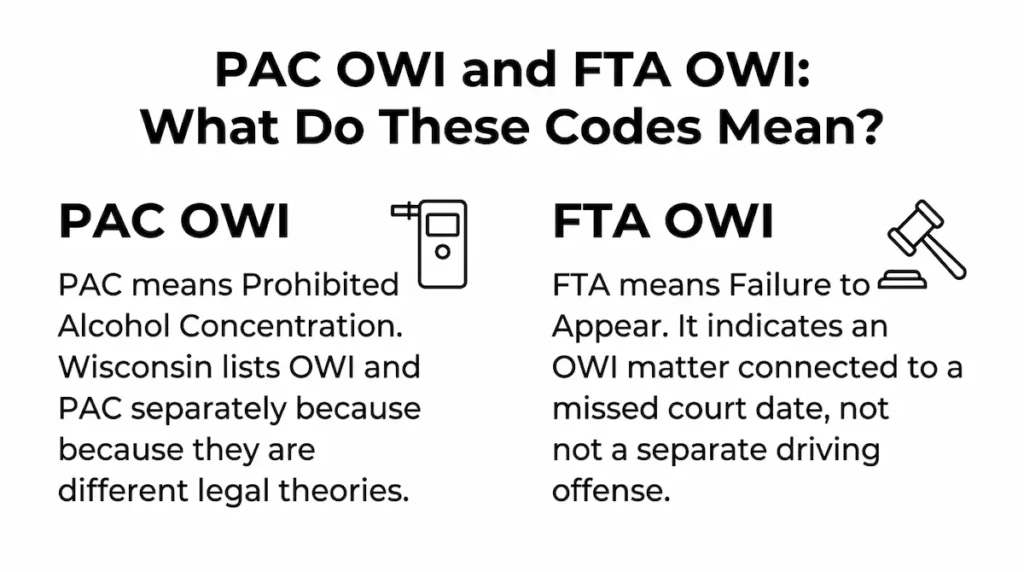
PAC means Prohibited Alcohol Concentration in Wisconsin impaired-driving records. Wisconsin may list an OWI allegation and a PAC allegation separately because they are not identical legal theories. The applicable concentration depends on current law and the driver’s category and history; see the Wisconsin DOT explanation and Wis. Stat. § 346.63.
FTA OWI on a Court or Jail Record
FTA usually means Failure to Appear. “FTA OWI” normally indicates an OWI matter connected to a missed court appearance, not a separate impaired-driving offense. Because court codes and case status can vary, check the docket and contact the court that issued the record for its exact meaning.
Will an OWI Affect a Record, Background Check or Insurance?
A conviction may appear in criminal, court, or driving records, depending on the jurisdiction, record system, and type of background check. An arrest or pending charge may be reported differently from a conviction.
Insurance effects depend on the driving record, insurer, state rules, and policy terms. A prior DUI, DWI, or OWI may count as an earlier impaired-driving offense even when a different acronym was used; state lookback and counting rules control.
Since February 19, 2022, Michigan has allowed applications to set aside certain first-time OWI convictions. This state-specific process does not mean relief is available, automatic, or identical elsewhere.
Other Meanings of OWI and Common Mix-Ups
| Context | Meaning |
|---|---|
| Police, court, or driving law | Usually Operating While Intoxicated |
| World War II history | Office of War Information |
| Military-history search | Usually the wartime Office of War Information |
| French-language search | The intended word may be oui, meaning “yes” |
| OUI legal acronym | Operating Under the Influence |
The U.S. Office of War Information was established by Executive Order 9182 on June 13, 1942. It coordinated domestic and overseas information about the war effort as a civilian federal agency, not a branch of the armed forces, and was abolished in 1945.
In French, oui means “yes.” The legal acronym OUI has a separate meaning: Operating Under the Influence. “Owing” and “owie” are different words and are not alternate meanings of OWI.
What Should You Do After Seeing OWI on a Citation or Record?
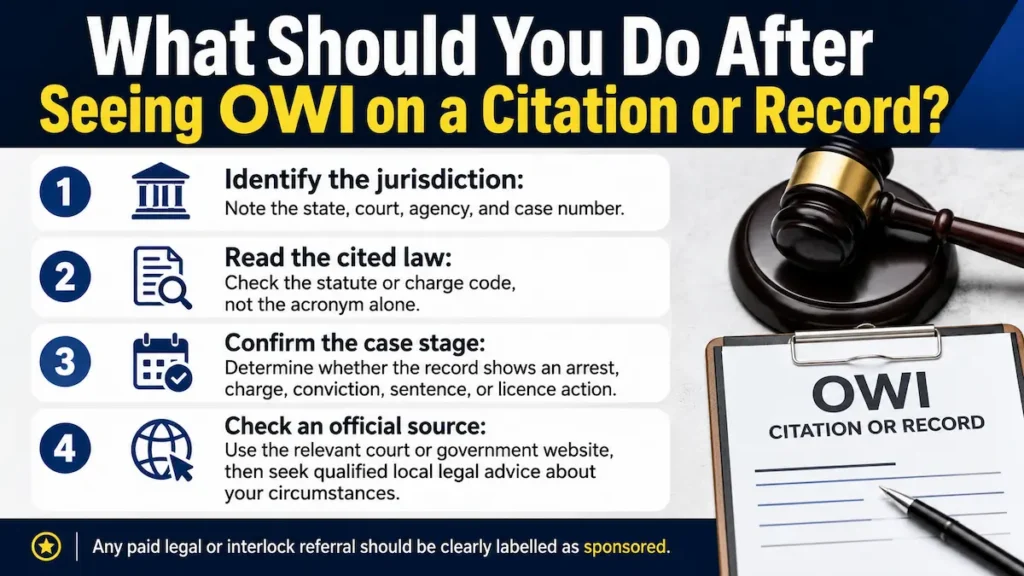
- Identify the jurisdiction: Note the state, court, agency, and case number.
- Read the cited law: Check the statute or charge code, not the acronym alone.
- Confirm the case stage: Determine whether the record shows an arrest, charge, conviction, sentence, or licence action.
- Check an official source: Use the relevant court or government website, then seek qualified local legal advice about your circumstances.
Any paid legal or interlock referral should be clearly labelled as sponsored.
Frequently Asked Questions About OWI
What does OWI stand for?
OWI most commonly stands for Operating While Intoxicated in impaired-driving law. The exact statutory wording and covered conduct depend on the state where the citation, arrest, or court case arose.
Is OWI the same as DUI?
They describe related impaired-driving conduct, but they are not universal legal synonyms. One state may use OWI while another uses DUI, and each statute can define different elements, offense levels, and consequences.
Is OWI worse than DUI?
Not automatically. The acronym does not determine seriousness. State law, prior offenses, alcohol concentration, drug involvement, injuries, child passengers, test refusal, and licence status may affect classification and possible sentencing.
Is an OWI always a felony?
No. An OWI may be treated as a civil forfeiture, misdemeanor, or felony depending on the jurisdiction, offense history, and facts such as injury, death, or another statutory aggravating factor.
Can prescription medicine lead to an OWI charge?
Yes. Lawful possession or use of prescription medicine does not prevent an allegation if authorities claim it impaired safe operation. The government must still prove the elements required by the controlling statute.
Can a person receive an OWI in a parked car?
Possibly, but no nationwide rule applies. Courts may consider vehicle movement, engine status, location, keys, the person’s position, and whether state law recognizes operation or actual physical control.
Does an OWI charge mean the person was convicted?
No. A charge is an allegation. A conviction follows a guilty plea or a court finding of guilt, while a sentence is imposed only after a conviction has been entered.
Will an OWI appear on a background check?
It may, depending on whether the record concerns an arrest, pending charge, or conviction, and on the databases searched. Court, criminal, and driving records can also follow different reporting rules.
Can an earlier DUI count as a prior OWI?
It may. State law determines whether earlier DUI, DWI, OWI, or similar convictions count as prior impaired-driving offenses and how long the applicable lookback period lasts.
What did OWI mean during World War II?
OWI meant the Office of War Information, a U.S. agency created on June 13, 1942, to coordinate domestic and overseas wartime information.
Sources, Review Method and Legal Notice
This page was researched from government, legislative, and court materials rather than random summaries. Each jurisdictional statement was checked separately because one state’s rule should not be presented as national law. The last legal verification date is June 17, 2026.
Readers can report factual or source errors through the Corrections page and its visible contact method. This page provides general educational information, not legal advice, and reading it does not create an attorney-client relationship. It has not been reviewed by an attorney. Source wording and linked laws should be checked again whenever the page is updated.
Primary sources
- Wisconsin Department of Transportation
- Iowa Legislature
- Michigan state government and courts
- Indiana state government and courts
- National Archives: Records of the Office of War Information