OWI Meaning in Wisconsin: What §346.63 Actually Prohibits
In Wisconsin, OWI means Operating While Intoxicated. It is the name Wisconsin law gives to impaired driving, and it comes from Wisconsin Statutes §346.63, “Operating under influence of intoxicant or other drug.” If “OWI” appears on a Wisconsin citation, court record, or driving record, §346.63 is the provision behind it. The broader meaning of OWI varies by state — in Wisconsin it has one specific statutory definition, and that definition is wider than most people expect.
The §346.63(1) definition has three separate prongs
Section 346.63(1) says no person may drive or operate a motor vehicle while any one of the following is true:
- Under the influence — the person is under the influence of an intoxicant, a controlled substance or analog, or a combination of them, or under the influence of any other drug to a degree that renders the person incapable of safely driving (§346.63(1)(a)).
- A detectable restricted controlled substance — the person has a detectable amount of a restricted controlled substance in his or her blood (§346.63(1)(am)).
- A prohibited alcohol concentration — the person has a prohibited alcohol concentration, usually shortened to PAC (§346.63(1)(b)).
These are distinct theories, not elements that must all be proved together. Under §346.63(1)(c), a prosecutor may charge any combination of the three for the same incident, but a guilty finding on a combination produces a single conviction for sentencing and counting purposes. WisDOT explains the paperwork the way a driver receives it: an “A ticket” for OWI under (1)(a), an “AM ticket” for a restricted controlled substance under (1)(am), and a “B ticket” for operating with a prohibited alcohol concentration (PAC).
“Operate” reaches further than “drive”
Wisconsin deliberately uses “operate” in its OWI label, and §346.63(3) defines the two words differently:
- “Drive” means exercising physical control over the speed and direction of a motor vehicle while it is in motion.
- “Operate” means physically manipulating or activating any of the controls of a motor vehicle necessary to put it in motion.
The vehicle does not have to be moving. WisDOT states the same point plainly: a driver can be operating while intoxicated even if the vehicle is not in motion at the time of the traffic stop. Nor is the law limited to public highways: under §346.61, §§346.62 to 346.64 also apply on premises held out to the public for motor vehicle use, employer-provided premises, and parking for tenants of rental housing in buildings of four or more units — though not on private parking areas at farms or single-family residences.
The alcohol prong: what counts as a prohibited alcohol concentration
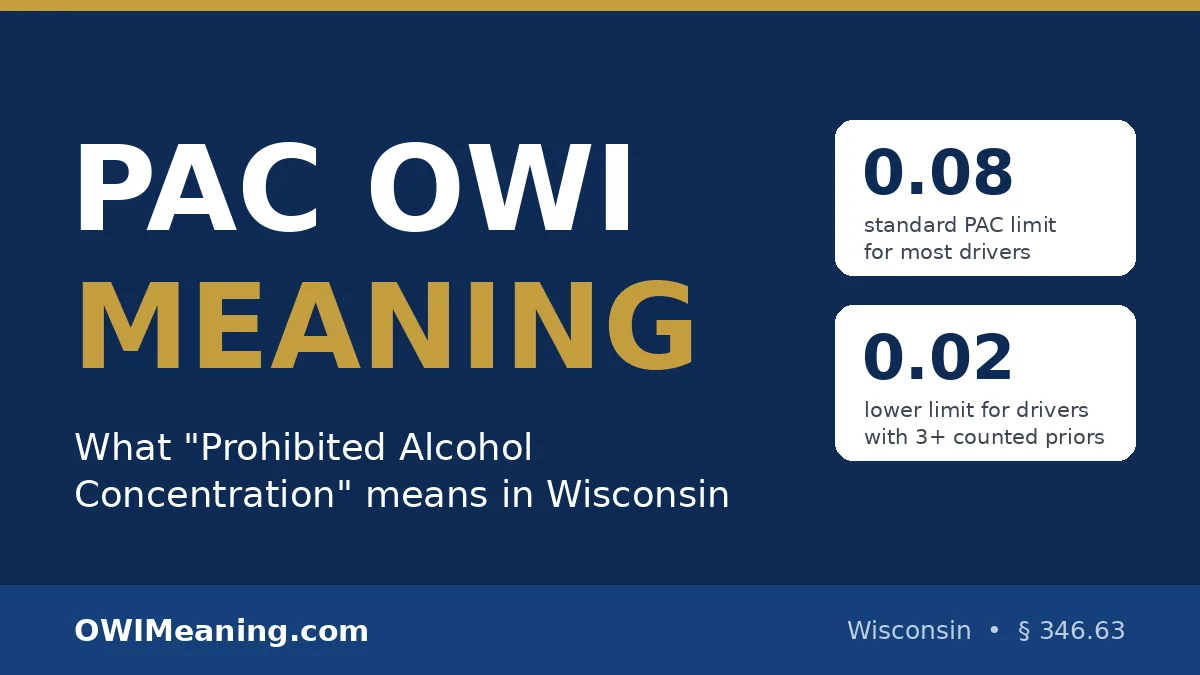
“Prohibited alcohol concentration” is a defined term, and the number depends on the driver’s history. Under §340.01(46m):
- For a person with two or fewer countable prior convictions, suspensions, or revocations, it is an alcohol concentration of 0.08 or more.
- For a person subject to an ignition interlock order under §343.301, or with three or more countable priors, it is an alcohol concentration of more than 0.02.
Two lower limits apply in specific settings: 0.04 or more for operating a commercial motor vehicle under §346.63(5), and more than 0.0 for drivers under the legal drinking age under §346.63(2m) — Wisconsin’s absolute sobriety rule for underage drivers.
A test result at or above the limit is not the only route to an OWI charge. Paragraph (1)(a) targets influence itself: WisDOT describes that category as a driver whose ability to safely operate a vehicle is impaired, separate from the BAC category.
The drug prong has no impairment threshold in its wording
Paragraph (1)(am) is written differently from the other prongs: it prohibits operating with a detectable amount of a restricted controlled substance in the blood, with no “incapable of safely driving” qualifier.
One statutory defense exists. Under §346.63(1)(d), in a case based on methamphetamine, gamma-hydroxybutyric acid, or delta-9-tetrahydrocannabinol (THC), the defendant has a defense if he or she proves by a preponderance of the evidence that he or she had a valid prescription for the substance at the time. It is a defense the defendant must prove — not an automatic exception.
A first offense is a civil forfeiture, not a criminal conviction
This is the part of Wisconsin law that surprises people from other states. OWI penalties sit in §346.65, and for a standard first offense §346.65(2)(am)1 provides that the person shall forfeit not less than $150 nor more than $300. A forfeiture is a civil penalty, so a standard first offense is not a criminal conviction and carries no jail time. On top of the forfeiture, §346.655 adds a $435 OWI surcharge, before ordinary court costs.
“Civil” does not mean minor, and exceptions can change the character of the case:
- A passenger under 16 in the vehicle. Under §346.65(2)(f)1, a first offense committed with a minor under 16 in the vehicle carries a fine of $350 to $1,100 and 5 days to 6 months in jail — criminal penalties, not a forfeiture — with a longer revocation.
- Injury to another person. Causing injury by operating while intoxicated is a separate offense under §346.63(2), with its own, more serious penalties in §346.65.
A citation is also only a charge. Penalties follow only if the court finds the person guilty; WisDOT’s first-offense guidance lists dismissal and not-guilty findings among the possible outcomes.
The license consequences run on two tracks
A Wisconsin OWI case affects the operating privilege twice, through different processes:
- Administrative suspension. After an arrest, the driver receives a Notice of Intent to Suspend. Under §343.305(7), the operating privilege is administratively suspended for six months, beginning 30 days from the notice date. The notice comes with information on requesting an administrative review hearing.
- Court-ordered revocation. If the person is convicted, the court revokes the operating privilege for 6 to 9 months under §343.30(1q)(b)2. For a first offense, the person can apply for an occupational license immediately.
A conviction also requires an assessment of alcohol and drug use and completion of a Driver Safety Plan. If the measured alcohol concentration was 0.15 or higher, or the person refused a chemical test, the person is restricted to vehicles equipped with an ignition interlock device — for a first offense, one year under §343.301.
Implied consent: refusing the test is its own violation
Under §343.305, a person who operates a motor vehicle on Wisconsin’s public highways is deemed to have consented to chemical tests of breath, blood, or urine when requested after an OWI arrest. Refusal does not end the matter. The officer issues a Notice of Intent to Revoke, and for a first refusal the operating privilege is revoked for one year under §343.305(10). The revocation begins 30 days after the notice unless the person requests a court hearing in writing within 10 days of the notice date. A refusal revocation can apply even apart from the outcome of the OWI charge itself.
Repeat offenses become criminal, then felony
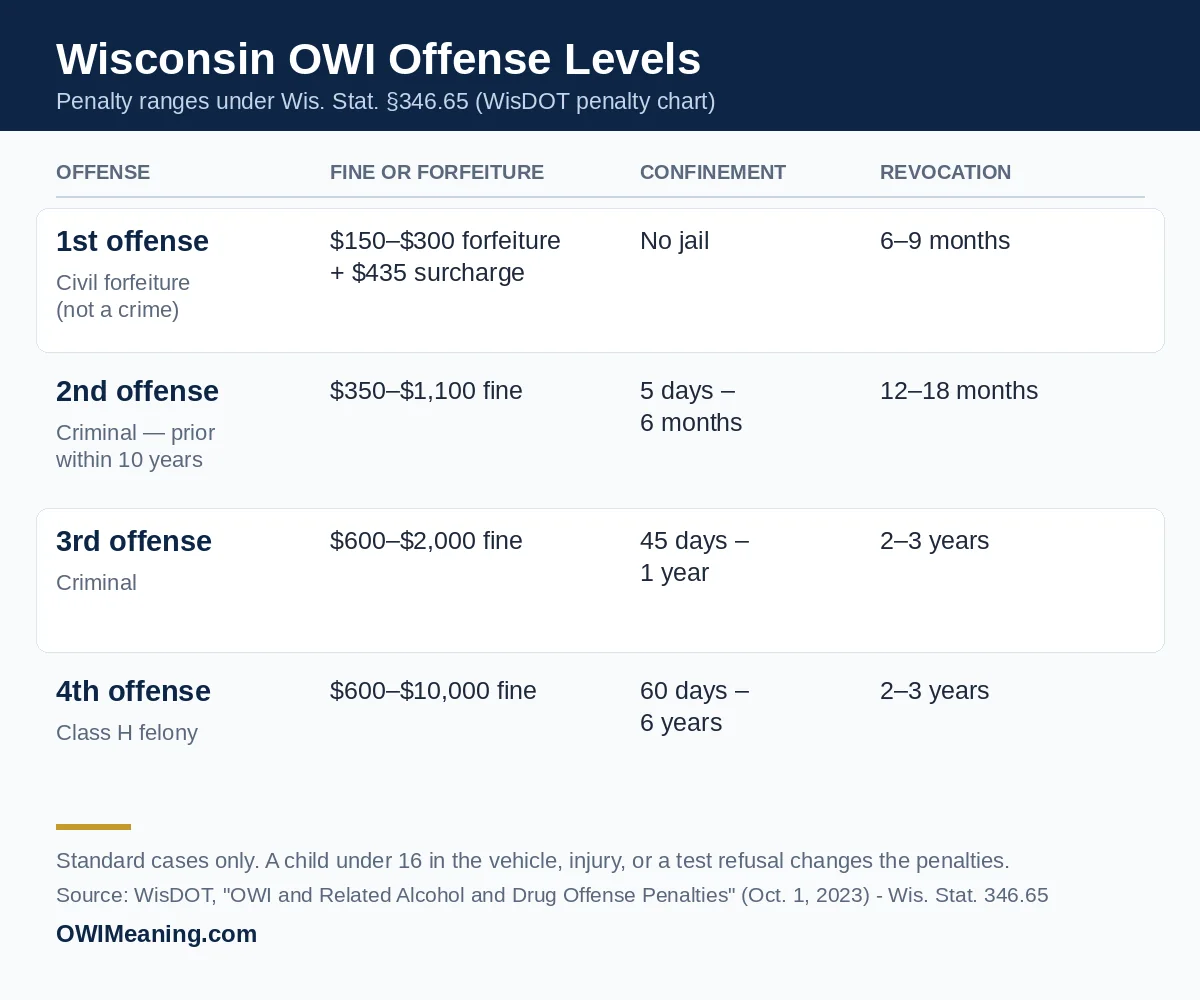
The civil treatment ends after the first offense. Under §346.65(2)(am) and the WisDOT penalty chart, the punishment for OWI escalates by count:
| Offense | Fine or forfeiture | Confinement | Revocation |
|---|---|---|---|
| First | $150–$300 forfeiture, plus $435 surcharge | None | 6–9 months |
| Second (prior within 10 years) | $350–$1,100 | 5 days to 6 months | 12–18 months |
| Third | $600–$2,000 | 45 days to 1 year | 2–3 years |
| Fourth | $600–$10,000 | 60 days to 6 years | 2–3 years |
A fourth offense is a Class H felony. Higher counts carry higher felony classes, and offenses involving injury or death are punished more severely still.
Why the Wisconsin record says OWI instead of DUI
Wisconsin is one of a handful of states that label this offense OWI; most states use DUI or DWI for closely related conduct. The label follows the Wisconsin statute — it does not signal a different kind of impairment. The general comparison of OWI vs DUI covers the state-by-state terminology; what is distinctive about Wisconsin is the combination behind the word: an “operate” standard that does not require motion, a per se drug prong based on detectability, and a first offense handled as a civil forfeiture.
Wisconsin OWI questions
Is a first OWI in Wisconsin a criminal offense?
A standard first offense is not. It is a civil forfeiture of $150 to $300 plus a $435 surcharge under §§346.65(2)(am)1 and 346.655, with a 6-to-9-month license revocation. It becomes criminal if, for example, a child under 16 was in the vehicle or someone was injured.
What blood alcohol level is illegal in Wisconsin?
For most drivers, a prohibited alcohol concentration is 0.08 or more. The limit drops to more than 0.02 for drivers with three or more countable priors or an ignition interlock order, 0.04 for commercial motor vehicles, and more than 0.0 for drivers under the legal drinking age.
Can you be charged with OWI if the car was not moving?
The statute covers “operating,” which §346.63(3)(b) defines as manipulating or activating a control necessary to put the vehicle in motion — motion itself is not required. Whether particular facts amount to operating is a question courts decide case by case.
Does an OWI citation mean the person was convicted?
No. A citation is a charge — an allegation. The forfeiture and court-ordered revocation apply only after the court finds the person guilty, although the administrative suspension and any refusal revocation under §343.305 run on their own timelines.
Sources
- Wisconsin Statutes §346.63, Operating under influence of intoxicant or other drug — Wisconsin Legislature: http://docs.legis.wisconsin.gov/statutes/statutes/346/X/63/1/a
- Wisconsin Statutes §346.63(3), definitions of “drive” and “operate” — Wisconsin Legislature: https://docs.legis.wisconsin.gov/document/statutes/346.63(3)
- Wisconsin Statutes §340.01(46m), “prohibited alcohol concentration” — Wisconsin Legislature: https://docs.legis.wisconsin.gov/statutes/statutes/340/01/46m/a
- Impaired driving (OWI) in Wisconsin — Wisconsin Department of Transportation: https://wisconsindot.gov/pages/dmv/license-drvs/susp-or-rvkd/owi.aspx
- First OWI offense — Wisconsin Department of Transportation: https://wisconsindot.gov/Pages/dmv/license-drvs/susp-or-rvkd/1stOWI.aspx
- OWI and Related Alcohol and Drug Offense Penalties (penalty chart, as of October 1, 2023) — Wisconsin Department of Transportation: https://wisconsindot.gov/Documents/safety/education/drunk-drv/owi-penchrt.pdf
Legal information verified on November 9, 2026.
Disclaimer: This page provides general educational information about Wisconsin law. It is not legal advice, does not create an attorney-client relationship, and is not a substitute for consulting a qualified Wisconsin attorney about a specific case.
4 Comments