OWI Meaning in Iowa: What Iowa Code §321J.2 Actually Says
In Iowa, OWI means Operating While Intoxicated. It is the name Iowa law gives to the impaired-driving offense in Iowa Code section 321J.2 — the charge that appears on Iowa citations and court records. Iowa does not use “DUI” as the name of this offense. The general meaning of OWI is the same phrase everywhere, but what the charge requires, how it is classified, and what it can cost are set by Iowa’s own statute, chapter 321J.
The Iowa definition
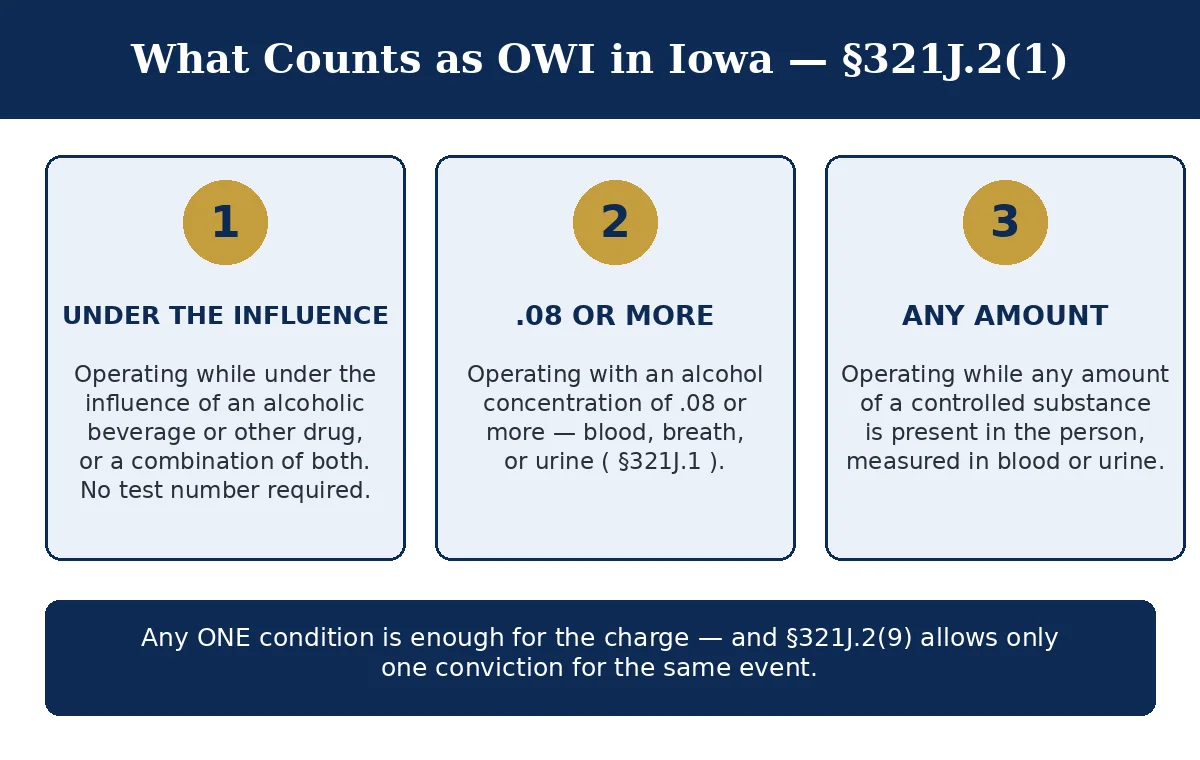
Section 321J.2(1) says a person commits operating while intoxicated by operating a motor vehicle in Iowa in any one of three conditions:
- While under the influence of an alcoholic beverage or other drug, or a combination of such substances.
- While having an alcohol concentration of .08 or more.
- While any amount of a controlled substance is present in the person, as measured in the person’s blood or urine.
The word “any” does real work there. The state does not have to prove all three conditions — one is enough to support the charge. Section 321J.2(9) adds the mirror-image protection: a person cannot be convicted and sentenced more than once under this section for the same event, even if more than one condition was present.
The three prongs, one by one
Under the influence. This prong has no number attached to it. It covers alcohol, another drug, or a mix of the two, and it turns on the person’s condition rather than a test result.
Alcohol concentration of .08 or more. This is the per se prong: the test result itself satisfies this part of the definition. Section 321J.1 defines “alcohol concentration” as grams of alcohol per 100 milliliters of blood, 210 liters of breath, or 67 milliliters of urine. Under section 321J.2(12), a specimen taken within two hours after driving is presumed to show the concentration at the time of driving.
Any amount of a controlled substance. For controlled substances, Iowa sets the line at any detectable amount in the blood or urine — section 321J.2(1)(c) writes in no minimum threshold. One qualification matters: section 321J.2(11) says the section does not apply to a person operating under the influence of a drug prescribed for them and taken as directed, where there is no evidence of alcohol consumption and the practitioner had not told them to refrain from operating a motor vehicle. The same subsection allows an affirmative defense to the “any amount” prong where the substance was prescribed or dispensed and taken as directed.
Testing under Iowa’s implied consent law
Section 321J.6 is Iowa’s implied consent provision. A person who operates a motor vehicle in Iowa under circumstances giving reasonable grounds to believe they were violating section 321J.2 is deemed to have consented to chemical testing of blood, breath, or urine, administered at the written request of a peace officer — one listed condition being that the officer has lawfully arrested the person for violating section 321J.2.
The peace officer chooses which specimen is tested. Refusing a breath or urine test counts as a refusal; refusing a blood test alone is not deemed a refusal, and the officer then offers one of the other two tests instead. Section 321J.8 requires the officer to advise the person beforehand that refusing brings a revocation under section 321J.9, and that a test showing a prohibited alcohol concentration or a drug brings one under section 321J.12.
Your license is a separate case, handled by the Iowa DOT
An Iowa OWI produces two proceedings. The criminal charge moves through court. The license action is administrative, run by the Iowa Department of Transportation, which states that driving privileges will be revoked after an OWI offense even if the person is not convicted in court.
The administrative revocation periods in chapter 321J are:
| Situation | Revocation period |
|---|---|
| Test taken, results at or over the prohibited level (§321J.12) | 180 days if no previous revocation under chapter 321J; 1 year if there has been a previous revocation |
| Test refused (§321J.9) | 1 year if no previous revocation under chapter 321J; 2 years if there has been a previous revocation |
A revocation generally takes effect ten days after the DOT mails the notice, and an officer who serves immediate notice at the roadside takes the Iowa license and issues a temporary license valid for ten days. Section 321J.13 gives the person the right to contest the revocation, but the request for a hearing must be made within ten days of receiving the notice. The DOT also assesses a $200 civil penalty on a revocation under this chapter (§321J.17).
Some drivers can apply for a temporary restricted license (TRL). The DOT’s conditions include being over 18, that the OWI did not cause a death, and — for a first offense — an ignition interlock device on all vehicles the person will drive. Reinstatement after the revocation ends requires the $200 civil penalty, an approved drinking driver course, a substance use disorder evaluation and any recommended treatment, SR-22 insurance proof for two years from the first day of revocation, interlock proof where it applies, and a $20 reinstatement fee plus the license fee.
What a first OWI conviction carries in Iowa
A first offense is a serious misdemeanor under section 321J.2(2)(a). On conviction, section 321J.2(3) sets the punishment as all of the following:
- Imprisonment in the county jail for a minimum of 48 hours and up to one year, with credit for time already confined after arrest.
- A fine of $1,250. If no personal or property injury resulted, the court may waive up to $625 of it when the defendant presents a temporary restricted license under section 321J.20. Surcharges and fees under chapter 911 also apply.
- License revocation for a minimum of 180 days and up to one year, under section 321J.4(1), 321J.9, or 321J.12, with an ignition interlock device required on all vehicles the person operates if they seek a temporary restricted license.
- Assignment to substance use disorder evaluation and treatment, a course for drinking drivers, and, if available and appropriate, a reality education prevention program.
With the defendant’s consent, the court may instead defer judgment under section 907.3 and place the defendant on probation; completing probation ends in discharge without entry of judgment. Eligibility is limited — section 321J.2(3)(b) removes it in defined situations, including where a prior conviction or revocation combines with factors such as an alcohol concentration over .15, a test refusal, or bodily injury to another person. A deferred judgment still counts as a previous offense later (§321J.2(8)).
Second and third offenses
Iowa’s classification climbs quickly:
| Offense | Classification | Jail/prison minimum | Fine | License revocation |
|---|---|---|---|---|
| First | Serious misdemeanor | 48 hours (up to 1 year) | $1,250 | 180 days to 1 year |
| Second | Aggravated misdemeanor | 7 days (up to 2 years) | $1,875–$6,250 | 1 year (§321J.12) or 2 years (refusal, §321J.9 / §321J.4(2)) |
| Third and each subsequent | Class “D” felony | 30 days mandatory minimum, up to 5 years | $3,125–$9,375 | 6 years (§321J.4(4)) |
Every person convicted under the section must also undergo a substance use disorder evaluation before sentencing, at their own expense, and follow its recommendations (§321J.2(7)). Prior offenses are counted broadly: earlier deferred judgments count, and so do convictions in other states under substantially corresponding statutes (§321J.2(8)).
Why the paperwork says OWI, not DUI
OWI is simply the label Iowa’s legislature wrote into chapter 321J; the offense most states call DUI or DWI is, in Iowa, operating while intoxicated. Neighboring Wisconsin uses OWI as well, though under a completely different statute. The distinction between the labels, and which states use which term, is covered in our comparison of OWI vs DUI. What matters on an Iowa record is the section cited: “OWI” tied to section 321J.2 is a criminal charge under Iowa law, not a generic notation.
Questions readers ask about Iowa OWI
Is an OWI in Iowa a criminal offense or a traffic ticket?
It is a criminal offense: a serious misdemeanor the first time, an aggravated misdemeanor the second, and a class “D” felony the third (§321J.2(2)). The license revocation is a separate administrative action on top of the criminal case.
Does “OWI” on an Iowa record mean the person was convicted?
No. A record entry can reflect an arrest or a charge, which are allegations, not proof. A conviction exists only after a court enters judgment — and some first offenses end in a deferred judgment, which is a discharge without entry of judgment if probation is completed.
Can an Iowa driver lose their license without being convicted?
Yes. The test-result and refusal revocations in sections 321J.9 and 321J.12 are administrative. The Iowa DOT states that driving privileges will be revoked after an OWI offense even if the person is not convicted in court.
Is there a different rule for drivers under 21?
Yes. Section 321J.2A covers persons under twenty-one, and section 321J.12(5) sets a revocation of 60 days (90 days with a previous revocation) where a test shows an alcohol concentration of .02 or more but less than .08.
Does refusing the test make the revocation shorter or longer?
Longer. A first refusal brings a one-year revocation under section 321J.9, compared with 180 days for a first test-result revocation under section 321J.12 — and proof of refusal is admissible in court under section 321J.16.
Sources
- Iowa Code §321J.2 (Iowa Code 2026), Iowa Legislature: https://www.legis.iowa.gov/docs/code/321j.2.pdf
- Iowa Code chapter 321J (Iowa Code 2026), Iowa Legislature: https://www.legis.iowa.gov/docs/code/2026/321J.pdf — sections 321J.1, 321J.6, 321J.8, 321J.9, 321J.12, 321J.13, 321J.16 and 321J.17
- Iowa Department of Transportation, “Operating While Intoxicated (OWI)”: https://iowadot.gov/drivers-licenses-ids/suspensions-revocations/owi
Legal information verified on November 9, 2026.
Disclaimer: This article is general educational information about Iowa law as published in the sources above. It is not legal advice, does not create an attorney–client relationship, and is not a substitute for advice from a qualified Iowa attorney about a specific case. Laws change; check the current Iowa Code or consult an attorney for your situation.
One Comment