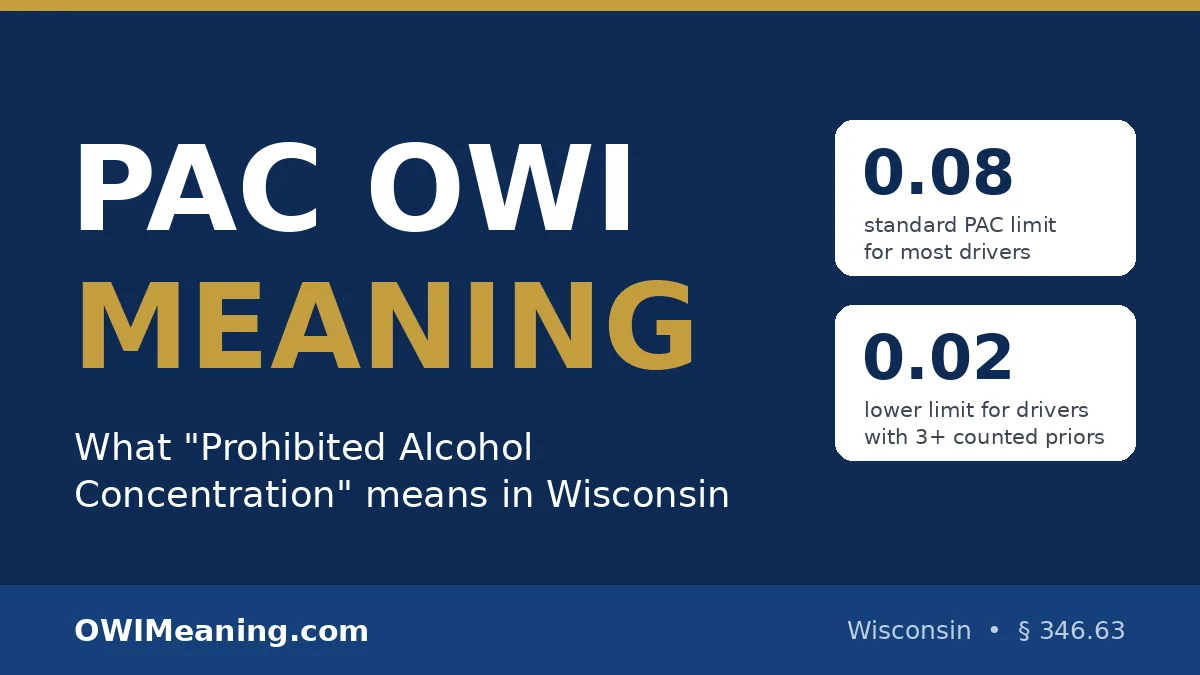
What Does PAC Mean Next to an OWI Charge in Wisconsin?
PAC stands for prohibited alcohol concentration. In Wisconsin, it is not a slang term or a police abbreviation invented for paperwork. It is a defined legal term, and when “PAC” appears next to OWI on a citation, complaint, or court record, it means the driver is accused of driving or operating a motor vehicle with an alcohol concentration above the limit the law sets for that driver.
That is a separate accusation from being impaired. Wisconsin law gives prosecutors two ways to charge the same stop, and PAC is the one built on a chemical test number rather than on observations of how the person was driving or behaving. For broader background, see our explainer on what OWI means.
Where the Term Shows Up
Most people meet the term PAC in one of four places:
- A traffic citation issued after a stop in Wisconsin, where PAC may appear as its own count alongside OWI.
- A criminal complaint, which lists each count and the statute paragraph behind it.
- A court record or docket entry, where “OWI” and “PAC” are often recorded as separate counts from a single arrest.
- A driving record or case summary summarizing the charges after the stop.
Seeing PAC on a document tells you which theory the state is using — not the outcome. A charge is an allegation; it becomes a conviction only if the person pleads guilty or no contest, or is found guilty in court.
The Statute Behind the Letters
Wisconsin’s impaired-driving statute is Wis. Stat. § 346.63, “Operating under influence of intoxicant or other drug.” Subsection (1) lists several distinct prohibitions. A person may not drive or operate a motor vehicle while:
- (a) under the influence of an intoxicant, a controlled substance, or a combination, to a degree that makes the person incapable of safely driving — this is the classic OWI count;
- (am) the person has a detectable amount of a restricted controlled substance in his or her blood; or
- (b) the person has a prohibited alcohol concentration — this is the PAC count.
The phrase “prohibited alcohol concentration” is then defined in Wis. Stat. § 340.01(46m). That definition, not a fixed number in § 346.63 itself, is what sets the limit — and the limit depends on the driver’s record.
The Two PAC Limits: 0.08 and 0.02
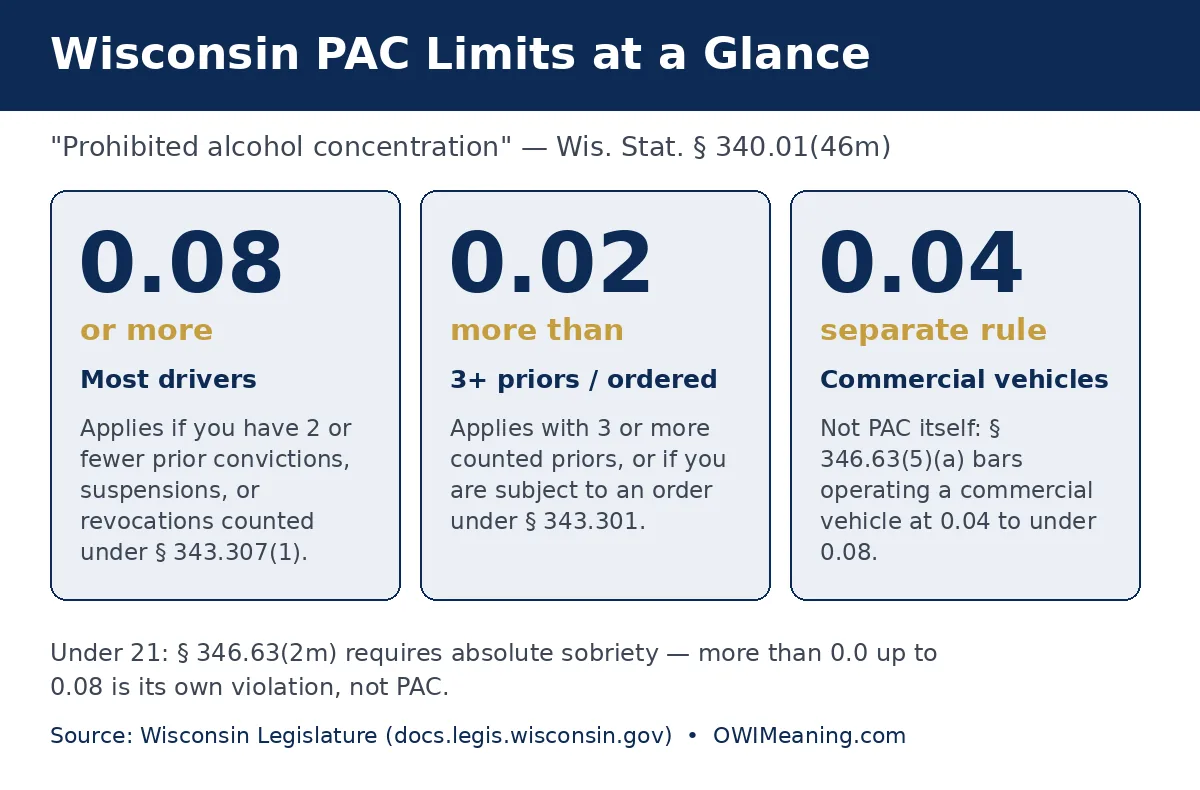
Under § 340.01(46m), “prohibited alcohol concentration” means one of the following:
| Driver | Prohibited alcohol concentration |
|---|---|
| A person with 2 or fewer prior convictions, suspensions, or revocations, as counted under Wis. Stat. § 343.307(1) | 0.08 or more |
| A person with 3 or more prior convictions, suspensions, or revocations, as counted under § 343.307(1) — or a person subject to an order under Wis. Stat. § 343.301 | More than 0.02 |
Two details are easy to miss. First, the counting is not just prior “OWI convictions” in the everyday sense; the statute counts convictions, suspensions, and revocations as tallied under § 343.307(1). Second, the thresholds are worded differently: the standard limit is reached at 0.08 or more, while the lower limit is more than 0.02. Alcohol concentration is measured in grams of alcohol per 100 milliliters of blood, as the Wisconsin Department of Transportation (WisDOT) notes on its impaired-driving page.
Two nearby rules that are not PAC
Two other Wisconsin rules use different numbers and are often confused with PAC:
- Commercial vehicles. Wis. Stat. § 346.63(5)(a) separately prohibits driving or operating a commercial motor vehicle with an alcohol concentration of 0.04 or more but less than 0.08. WisDOT likewise lists 0.04 for drivers operating a commercial vehicle at the time of the stop.
- Drivers under the legal drinking age. Wis. Stat. § 346.63(2m) prohibits a person who has not reached the legal drinking age from driving or operating with an alcohol concentration of more than 0.0 but not more than 0.08. WisDOT describes this as an absolute sobriety requirement for drivers under 21. It is its own subsection with its own penalty structure, not a PAC charge.
PAC vs. OWI, Side by Side
| Question | OWI count — § 346.63(1)(a) | PAC count — § 346.63(1)(b) |
|---|---|---|
| What is the state claiming? | The driver was under the influence to a degree that made them incapable of safely driving | The driver’s alcohol concentration was at or above the prohibited level for that driver |
| What sits at the center of the proof? | Observations and evidence of impairment — driving behavior, appearance, performance | A chemical test result showing the concentration |
| Does the state need to show the driver felt or acted drunk? | Impairment is the core of the charge | No — the charge turns on the number, not on visible impairment |
| Which limit applies? | No single test number defines the charge | 0.08 or more for most drivers; more than 0.02 for drivers with 3+ counted priors or a § 343.301 order |
In plain terms: OWI asks how impaired was this person? PAC asks what did the test show? A driver who insists “I felt fine to drive” has not answered a PAC count, because the PAC theory does not depend on how the driver felt.
Two Counts From One Stop — and One Conviction
A single stop can produce both counts. Section 346.63(1)(c) says a person may be charged with, and a prosecutor may proceed on, any combination of the impairment, restricted-controlled-substance, and PAC paragraphs for acts arising out of the same incident, and the offenses are joined.
The same paragraph limits the end result: if the person is found guilty of a combination of those paragraphs for the same incident, there is a single conviction for purposes of sentencing and for purposes of counting convictions. The statute adds that each paragraph requires proof of a fact the others do not — which is exactly why both can be charged even though they merge into one conviction.
PAC also appears in a more serious setting. Under § 346.63(2)(a), it is unlawful to cause injury to another person by operating a vehicle while, among other alternatives, having a prohibited alcohol concentration (§ 346.63(2)(a)2.). So the same three letters can show up in an injury case, where far more is at stake. How Wisconsin OWI penalties escalate with priors and circumstances is covered on our OWI punishment page, and the state rules behind these charges are gathered on our OWI in Wisconsin page.
What a PAC Charge Does — and Does Not — Prove
What it does: A PAC count tells you the state is relying on a test result at or above the driver’s prohibited level, under a definition that already accounts for that driver’s prior record. It identifies the theory, the limit that applied, and the paragraph — § 346.63(1)(b) — the count rests on.
What it does not do: A PAC entry is not a conviction, and it is not proof by itself that the person was visibly impaired, caused an accident, or will be found guilty. Charge lines describe allegations at the start of a case; outcomes depend on what the record shows later — a plea, a verdict, an amendment, or a dismissal. Read the charge line and the disposition line separately.
Frequently Asked Questions
Is PAC a separate charge from OWI in Wisconsin?
Yes, in the sense that it is a separate count under a separate paragraph — § 346.63(1)(b) instead of § 346.63(1)(a). But both counts come out of § 346.63(1), can arise from one stop, and if the person is found guilty of both for the same incident, the statute provides for a single conviction for sentencing and counting purposes.
Can someone be charged with PAC if they did not seem drunk?
Yes. The PAC paragraph turns on alcohol concentration, not on proof that the driver was incapable of safely driving. Visible impairment is the territory of the (1)(a) OWI count.
Why does the 0.02 limit apply to some drivers and not others?
Because § 340.01(46m) defines the prohibited concentration by the driver’s history. Drivers with 3 or more prior convictions, suspensions, or revocations counted under § 343.307(1), and drivers subject to an order under § 343.301, have a prohibited concentration of more than 0.02. Most other drivers are at 0.08 or more.
Does “PAC” mean the same thing in other states?
No. PAC, in this prohibited-alcohol-concentration sense, is Wisconsin’s statutory term. Other states use their own labels and structures for test-based impaired-driving charges, so a Wisconsin PAC count should not be read as if it were a charge from another state.
Sources
- Wisconsin Statutes § 346.63, “Operating under influence of intoxicant or other drug” — Wisconsin Legislature: https://docs.legis.wisconsin.gov/statutes/statutes/346/X/63
- Wisconsin Statutes § 340.01(46m), definition of “prohibited alcohol concentration” — Wisconsin Legislature: https://docs.legis.wisconsin.gov/statutes/statutes/340/01/46m
- “Impaired driving (OWI) in Wisconsin” — Wisconsin Department of Transportation (WisDOT): https://wisconsindot.gov/pages/dmv/license-drvs/susp-or-rvkd/owi.aspx
Legal information verified on November 9, 2026.
Disclaimer: This article is general legal information about Wisconsin terminology and statutes. It is not legal advice, does not create an attorney–client relationship, and is not a substitute for advice from a qualified Wisconsin attorney about a specific case. Laws change; check the current statute text before relying on it.