FTA OWI Meaning: Failure to Appear on an OWI Record
FTA next to an OWI charge means “Failure to Appear.” It records that the person named in an OWI case did not show up for a scheduled court date. FTA is not a second impaired-driving offense, and it is not part of the OWI charge itself. It is a court-event notation: the case had a date, the person was required to be there, and the record shows they were not.
The two entries are read together on dockets, jail records, and background reports, and they look like one combined charge. They are not. The OWI charge is the underlying allegation about operating while intoxicated. The FTA is about what happened afterward, in court.
Where “FTA” shows up
FTA usually appears as a short code or event line rather than a full sentence:
- A court docket, as an event entry on the date of a missed hearing — often next to a note that a warrant was issued.
- A jail or booking record, where FTA may be listed as the reason for a custody booking after a warrant.
- A warrant list or court notice, where “FTA warrant” is shorthand for a warrant issued over the missed appearance.
- A background report, where a screening company may copy the docket’s FTA entry alongside the OWI case without explaining it.
In each setting, the FTA entry records the same event: a missed required appearance. It says nothing about blood alcohol concentration, driving behavior, or test results. For the underlying charge and how it differs from DUI and DWI terminology, see OWI vs DUI.
FTA and the OWI charge are two separate things
| OWI | FTA | |
|---|---|---|
| What it records | An allegation of operating while intoxicated | A missed scheduled court appearance in a case |
| Who creates it | Law enforcement and the prosecutor, by filing the charge | The court, when the person does not appear as required |
| What decides it | Evidence about driving, impairment, and testing | The court’s own record of attendance on a set date |
| Does it prove the other? | No | No — an FTA does not prove the OWI, and the OWI does not explain the FTA |
A person can have an FTA on a case that is later dismissed, and a person can be convicted of OWI without ever missing a date. The entries travel together because they belong to the same case, not because one establishes the other.
What typically happens after the missed date
Courts do not usually leave a missed appearance sitting idle. The most common response is a bench warrant — a court order authorizing law enforcement to arrest the person for failing to appear for a hearing or failing to comply with a court order, as the New Jersey Courts glossary puts it. Arizona courts’ self-help guidance describes the same pattern: bench warrants are typically issued when a defendant fails to appear, the person can be arrested once the warrant is issued, and only a judicial officer can quash or cancel it.
Wisconsin law shows the mechanics in statutory form. Under Wis. Stat. § 968.09(1), when a defendant fails to appear as required, or violates a term of bond or probation, the court may issue a bench warrant directing that the person be brought before the court without unreasonable delay, stating the reason on the record. Two points in that wording matter: the warrant is discretionary (“may”), and its purpose is to bring the person back before the court — a tool to restart the case, not a ruling on the OWI.
A warrant is not the only possible path. In Wisconsin traffic and forfeiture proceedings under chapter 345, Wis. Stat. § 345.37 gives the court a second option when a defendant misses the date fixed in a citation: instead of issuing a warrant, the court may treat the nonappearance as a plea of no contest and enter judgment; in either path, a bond posted for that appearance may be ordered forfeited. Notice of the judgment must be mailed, with at least 20 days allowed for payment. Which route a case takes depends on the court, the type of proceeding, and the state — there is no single nationwide sequence.
Can an FTA become a charge of its own?
In some states, yes — but under that state’s own statute, with its own elements, and not automatically. Wisconsin provides a documented example. Its bail jumping statute, Wis. Stat. § 946.49, covers a person released under a bond who intentionally fails to comply with the bond’s terms; where the underlying offense is a misdemeanor, that is a Class A misdemeanor, and where it is a felony, a Class H felony. Court annotations stress the intent element: the state must prove the person knew the bond terms and intentionally did not comply, and a person released without a bond is not subject to the section at all. Other states draw this line in different places. Do not assume your state’s rule matches Wisconsin’s.
An FTA is not a finding of guilt on the OWI
Reading an FTA entry as “guilty” is the most common misreading of these records. A bench warrant under § 968.09 is issued to compel an appearance; it decides nothing about whether the person operated while intoxicated. The OWI allegation still has to be resolved in the case.
One qualification belongs here. In forfeiture-style proceedings like the Wisconsin chapter 345 process above, a court that treats nonappearance as a no-contest plea can enter a judgment that functions as a conviction on the underlying citation unless reopened. Section 345.37 allows the defendant to move within six months to open that judgment by showing the failure to appear was due to mistake, inadvertence, surprise, or excusable neglect; if opened, the court accepts a not guilty plea, sets a trial date, and notifies the Department of Transportation to delete the conviction record from the original judgment. An FTA can therefore shape how an OWI case is resolved, even though it is not proof of the OWI.
How an FTA entry gets resolved
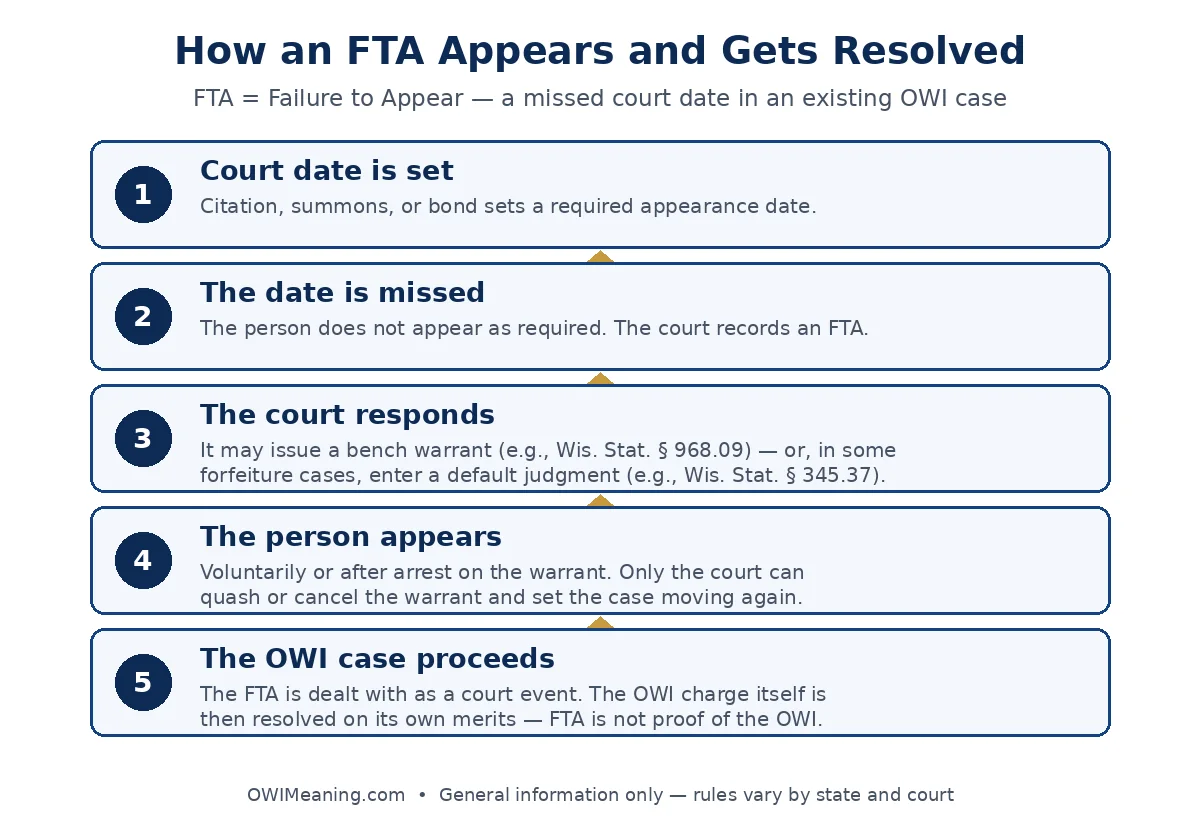
An FTA does not expire on a schedule or clear itself. Resolution runs through the court that issued the requirement to appear:
- The person comes before the court — voluntarily, or after arrest on the bench warrant. Arizona courts note a warrant stays in effect until the individual is arrested or appears before the court to address it.
- The court deals with the warrant and the missed date and sets the case moving again with a new date or further orders.
- Any default judgment is addressed through that court’s procedures — in Wisconsin chapter 345 cases, through the motion to open described above (six-month window; mistake-or-excusable-neglect standard).
- The underlying OWI case then proceeds on its own merits, separately from the FTA event.
Because the issuing court’s procedures control each step, the practical first move is to contact the clerk of the court named on the record for the case status and what appearance is required, or to have an attorney in that state do so. Wisconsin readers can see how these codes sit inside the wider Wisconsin OWI framework.
Frequently asked questions
Does FTA OWI mean a new OWI charge?
No. FTA records a missed court date in an existing OWI case. In some states, though, a deliberate failure to comply with bond conditions can be charged as its own offense.
Is there automatically a warrant if a record shows FTA?
Not automatically. A bench warrant is the typical response, and Wisconsin’s § 968.09 says the court “may” issue one — but some proceedings allow a default judgment instead, and practices differ by state and court. The record, or the clerk of court, will show whether a warrant is active.
Does an FTA mean the person was convicted of OWI?
No. An FTA shows a missed appearance; a conviction is a separate outcome. The exception is a default judgment entered after a missed date in a forfeiture-type proceeding, which can stand unless the person moves to reopen it under that state’s procedure.
How long does an FTA stay on a record?
There is no verified nationwide rule. An FTA is part of the court’s case record, and a related warrant generally remains in effect until the person appears before the court or is arrested on it. Visibility depends on the court and the case outcome.
Sources
- Wis. Stat. § 968.09, “Warrant on failure to appear”: https://docs.legis.wisconsin.gov/2023/statutes/statutes/968/09/1
- Wis. Stat. § 345.37, “Procedure on default of appearance”: https://docs.legis.wisconsin.gov/2019/statutes/statutes/345/iii/37
- Wis. Stat. § 946.49, “Bail jumping”: https://docs.legis.wisconsin.gov/statutes/statutes/946/iv/49?view=section
- “Bench Warrant” glossary — New Jersey Courts: https://www.njcourts.gov/glossary/bench-warrant-0
- “Warrants” — Arizona Judicial Branch: https://www.azcourts.gov/selfservicecenter/Criminal-Law/Warrants
Legal information verified on November 9, 2026.
This page is general educational information about legal terminology and court records. It is not legal advice and is not a substitute for a qualified attorney in the state where a case is pending.