OWI Punishment: What a First Offense Carries in Wisconsin, Iowa, Michigan and Indiana
There is no single OWI punishment in the United States. OWI — operating while intoxicated — is a state charge, and each state that uses the term sets its own classification, fine, jail exposure and license sanction. A first offense that is a civil forfeiture in one state is a criminal misdemeanor with mandatory jail time in another.
This page compares Wisconsin, Iowa, Michigan and Indiana using figures checked against each state’s current statute or transportation agency. Every figure is the range the law allows for a first offense: a statute sets the floor and the ceiling, it does not predict what a court will impose in a given case, and a charge is not a conviction.
Why there is no single OWI punishment
Impaired driving is prosecuted under state law, not federal law. Legislatures answer three questions differently: whether a first offense is civil or criminal, how much weight a prior record carries, and whether the license consequence comes from the court, the licensing agency, or both. Wisconsin answers the first question differently from almost every other state. Iowa builds in a mandatory minimum jail term. Michigan ties part of its structure to a high alcohol concentration of 0.17; Indiana classifies the offense by alcohol concentration. Any website quoting one nationwide fine or jail range for “OWI” is inventing the number.
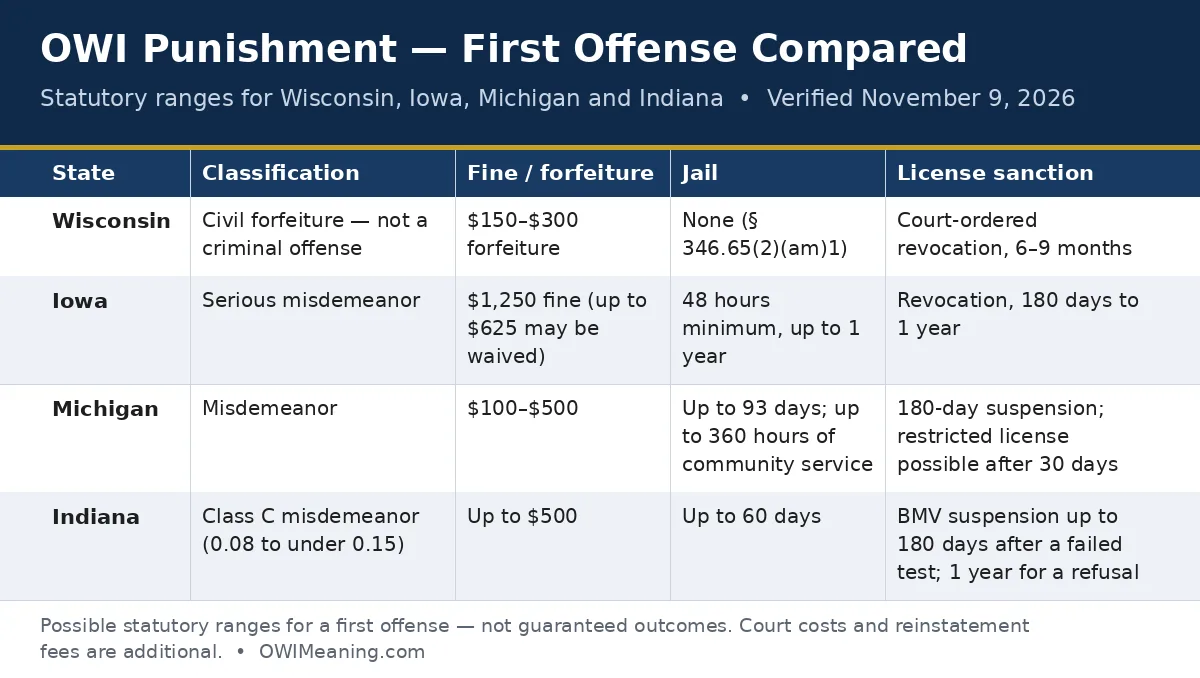
First-offense OWI punishment compared
First offense, adult driver, no priors, no aggravating facts such as a crash or a child passenger.
| State | Classification (first offense) | Fine or forfeiture | Jail exposure | License sanction |
|---|---|---|---|---|
| Wisconsin | Civil forfeiture — not a criminal offense | $150–$300 forfeiture | None (§ 346.65(2)(am)1) | Court-ordered revocation, 6–9 months |
| Iowa | Serious misdemeanor | $1,250 fine (up to $625 may be waived) | 48 hours minimum, up to 1 year | Revocation, 180 days to 1 year |
| Michigan | Misdemeanor | $100–$500 | Up to 93 days; up to 360 hours of community service | 180-day suspension; restricted license possible after 30 days |
| Indiana | Class C misdemeanor (0.08 to under 0.15) | Up to $500 | Up to 60 days | BMV suspension up to 180 days after a failed test; 1 year for a refusal |
Court costs, surcharges and reinstatement fees are added on top of these figures in most cases, and the rows change once the facts change — a higher alcohol concentration, a prior, or a young passenger can move a case into a different bracket.
Wisconsin: a forfeiture first, jail only from the second offense
Wisconsin’s penalty statute, Wis. Stat. § 346.65(2)(am), sets the first offense apart: a person with no countable priors “shall forfeit not less than $150 nor more than $300.” No jail term attaches to that paragraph, because the first offense is a civil forfeiture rather than a crime.
At the second offense, § 346.65(2)(am)2 requires a fine of $350 to $1,100 and imprisonment of 5 days to 6 months. A third carries a fine of $600 to $2,000 and 45 days to one year in county jail under § 346.65(2)(am)3, and a fourth is a Class H felony. The license consequence is separate: under Wis. Stat. § 343.30(1q), the court revokes the person’s operating privilege for 6 to 9 months after a first conviction, with eligibility for an occupational license at any time. WisDOT also describes a six-month administrative suspension that can begin before the court case ends. See OWI meaning in Wisconsin.
Iowa: a serious misdemeanor with a mandatory 48 hours
Iowa Code § 321J.2(2)(a) classifies a first offense as a serious misdemeanor. Section 321J.2(3) sets the punishment: county jail for a minimum of 48 hours and not more than one year, and a fine of $1,250. The court may waive up to $625 of that fine if no personal or property injury resulted and the defendant presents a temporary restricted license; unpaid community service may substitute for part or all of the fine. The same subsection adds license revocation of at least 180 days and up to one year.
A second offense is an aggravated misdemeanor under § 321J.2(2)(b) — 7 days to 2 years in jail and a fine of $1,875 to $6,250 — and a third is a Class “D” felony, with a six-year revocation. The Iowa DOT stresses that its revocation runs on its own track: privileges are revoked even without a court conviction, because the DOT acts on the test result or refusal, not the verdict. More detail: OWI meaning in Iowa.
Michigan: up to 93 days, with a separate high-BAC tier
Under MCL 257.625(9)(a), a first-offense OWI conviction in Michigan is a misdemeanor punishable by one or more of the following: community service for not more than 360 hours, imprisonment for not more than 93 days, or a fine of not less than $100 or more than $500. The paragraph sets no mandatory minimum jail term.
Michigan also raises the first-offense ceiling on alcohol concentration. A conviction under MCL 257.625(1)(c) — an alcohol content of 0.17 or more — raises maximum imprisonment to 180 days and the fine range to $200 to $700, still within subsection (9)(a). The license sanction is imposed through the Secretary of State rather than set by the sentencing judge: a first conviction brings a 180-day suspension under MCL 257.319, with a restricted license available after the first 30 days.
Indiana: the misdemeanor class depends on the test result
Indiana splits its first offense by alcohol concentration. Under IC 9-30-5-1(a), operating with an alcohol concentration of at least 0.08 but less than 0.15 is a Class C misdemeanor; operating while intoxicated, without a qualifying test figure, is also a Class C misdemeanor under IC 9-30-5-2(a). A Class C misdemeanor carries up to 60 days in jail and a fine of up to $500 (IC 35-50-3-4).
At 0.15 or more, IC 9-30-5-1(b) makes the offense a Class A misdemeanor, as does operating in a manner that endangers a person under IC 9-30-5-2(b) — up to one year in jail and a fine of up to $5,000 under IC 35-50-3-2. License consequences start before conviction: the BMV can suspend privileges for up to 180 days after a failed test, and for one year after a first refusal; a court may add its own suspension after conviction. See also OWI vs DUI.
What pushes OWI punishment higher
Prior offenses are the largest single factor. Wisconsin moves from a forfeiture to mandatory jail at the second countable offense and to a felony at the fourth. Iowa moves to an aggravated misdemeanor, then to a Class “D” felony at the third. Michigan makes a conviction after two or more priors a felony: a fine of $500 to $5,000 and one to five years in prison, or probation with county jail time. Indiana: a Level 6 felony with a previous OWI conviction within seven years (IC 9-30-5-3(a)(1)).
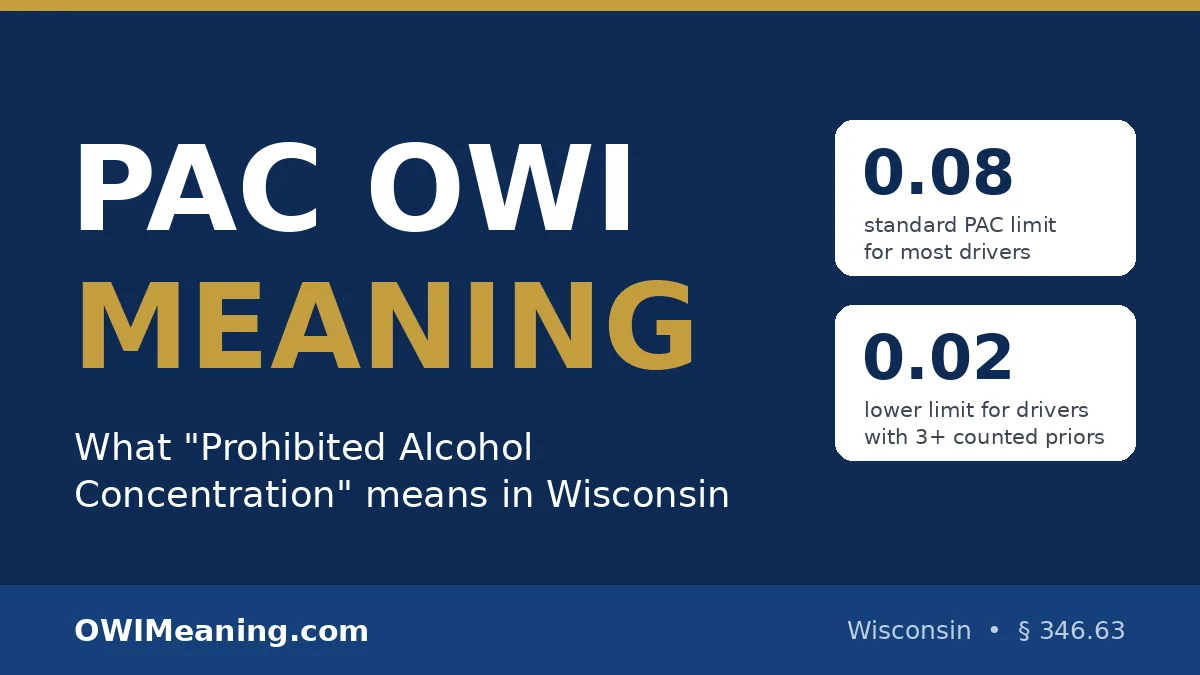
A high alcohol concentration matters in three states. Michigan’s 0.17 tier and Indiana’s 0.15 tier are described above. Wisconsin instead multiplies fines for repeat offenders at high concentrations under § 346.65(2)(g) — doubled at 0.17, tripled at 0.20, quadrupled at 0.25.
A young passenger changes the case in three states. Wisconsin’s § 346.65(2)(f)1 turns even a first offense into a criminal penalty — $350 to $1,100 and 5 days to 6 months — when a passenger under 16 was in the vehicle; § 346.65(2)(f)2 doubles fines and imprisonment for higher counts. Michigan’s MCL 257.625(7)(a) adds a separate misdemeanor for a passenger under 16: a fine of $200 to $1,000 plus up to one year in jail or 30 to 90 days of community service. In Indiana, an adult who commits specified OWI offenses with a passenger under 18 commits a Level 6 felony (IC 9-30-5-3(a)(2)).
Injury or death leaves the standard structure entirely. In Michigan, causing a death is a felony punishable by up to 15 years in prison or a fine of $2,500 to $10,000, or both (MCL 257.625(4)); causing serious impairment of a body function is a felony punishable by up to 5 years or a fine of $1,000 to $5,000, or both (MCL 257.625(5)). Indiana and Wisconsin charge injury and death under their own felony sections — IC 9-30-5-4 and IC 9-30-5-5, and Wis. Stat. §§ 940.25 and 940.09.
Civil or criminal? Why Wisconsin’s first offense reads differently
Sources on Wisconsin often look inconsistent because they mix two different things. The forfeiture under § 346.65(2)(am)1 is a civil penalty: no jail, and the case is not a criminal prosecution. That treatment ends as soon as a countable prior exists — the second offense is a criminal case with mandatory imprisonment. The first offense is not consequence-free, though: it is recorded, the operating privilege is revoked for 6 to 9 months, an assessment and driver safety plan are required, and it counts as a prior. In Iowa, Michigan and Indiana, a first offense is a criminal misdemeanor from the start.
License consequences are not the same as court punishment
The fine and the license period are not one sentence, and they come from different authorities. The court imposes the fine or forfeiture, any jail term, community service and, in Wisconsin, the revocation that follows conviction. The licensing agency — WisDOT, the Iowa DOT, the Michigan Secretary of State, or the Indiana BMV — acts on the arrest, the test result or the refusal, and on the conviction record. That is why a license can be suspended before a verdict, and why reducing a charge does not automatically restore driving privileges. Reinstatement has its own requirements; in Iowa, the DOT lists a $200 civil penalty, a drinking-driver course, a substance use disorder evaluation, and SR-22 proof.
Frequently asked questions
Is an OWI a felony for a first offense?
Not in any of the four states compared here. Wisconsin treats it as a civil forfeiture; the other three treat it as a misdemeanor. Felony exposure arrives with prior convictions, a young passenger in Indiana, or injury and death.
What is the jail time for a first OWI?
Wisconsin: none. Iowa: a minimum of 48 hours, up to one year. Michigan: up to 93 days, with no stated minimum. Indiana: up to 60 days for a Class C misdemeanor, or up to one year for a Class A misdemeanor.
Does an OWI charge mean the punishment has already been decided?
No. These figures are the ranges a statute authorizes after a conviction. An arrest or citation starts a case; it does not establish guilt, and courts sentence within the range on the facts proven and the record.
Why do other websites give different OWI penalty numbers?
Usually because the page describes a different state, uses an older statute, or averages figures that no single state uses. The current statute of the state where the charge was filed is the only reliable check.
Sources
- Wisconsin Legislature — Wis. Stat. § 346.65, penalty for violating §§ 346.62 to 346.64: https://docs.legis.wisconsin.gov/document/statutes/346.65(2i)
- Wisconsin Legislature — Wis. Stat. § 343.30(1q), court-ordered revocation periods: https://docs.legis.wisconsin.gov/document/statutes/343.30(1z)
- Wisconsin Department of Transportation — First OWI offense: https://wisconsindot.gov/Pages/dmv/license-drvs/susp-or-rvkd/1stOWI.aspx
- Iowa Legislature — Iowa Code § 321J.2 (Iowa Code 2026): https://www.legis.iowa.gov/docs/code/321j.2.pdf
- Iowa Legislature — Iowa Code § 321J.12, test-result revocation: https://www.legis.iowa.gov/docs/code/2024/321J.12.pdf
- Iowa Department of Transportation — Operating While Intoxicated (OWI): https://iowadot.gov/drivers-licenses-ids/suspensions-revocations/owi
- Michigan Legislature — MCL 257.625, operating motor vehicle while intoxicated; penalties: https://www.legislature.mi.gov/Laws/MCL?objectName=mcl-257-625
- Michigan Legislature — MCL 257.319(8), license suspension and restricted license after an OWI conviction: https://www.legislature.mi.gov/Laws/MCL?objectName=mcl-257-319
- Indiana General Assembly — IC 9-30-5, operating a vehicle while intoxicated (Indiana Code, 2024 edition): https://iga.in.gov/laws/2024/ic/titles/9#9-30-5
- Indiana Bureau of Motor Vehicles — Common Traffic Violations (OWI license suspensions): https://www.in.gov/bmv/licenses-permits-ids/suspension-and-reinstatement/common-traffic-violations/
Legal information verified on November 9, 2026.
Disclaimer: This page is general legal information about how four states structure OWI penalties. It is not legal advice, it does not predict the outcome of any case, and it is not a substitute for a licensed attorney in the state where a charge was filed. Statutes change; confirm the current text before relying on any figure.